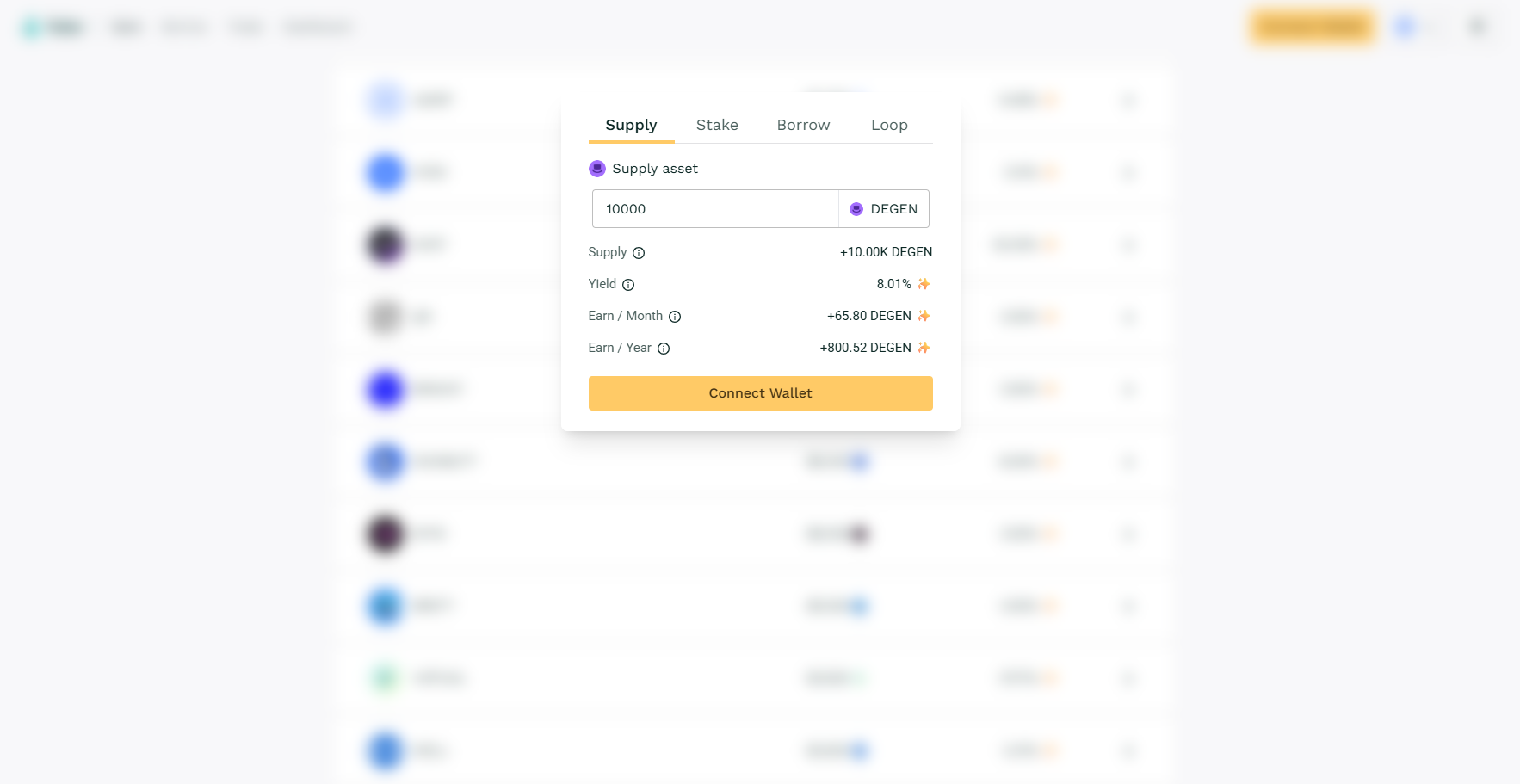
Lend DEGEN to Earn Yield on Teller


Are you holding $DEGEN on Base?
Lend on Teller and start earning 8-15% compounding yield.
No impermanent loss. No pairing. Withdraw anytime.
Just your $DEGEN, earning more $DEGEN while you keep full control of your position.
How Does Teller Work?
Teller is your new home base for earning yield on stables and long-tail assets. Join over 250k active users today and start earning up to 12% yield on Ethereum, Base, Arbitrum, and Hyperliquid.
The thesis is simple. No one should be limited to a small number of assets when lending and borrowing. Teller is a permissionless protocol designed to unlock liquidity and passive income on any asset.
Lenders deposit a single token and earn more of that same token, without dual-asset exposure or the risk of impermanent loss. Borrowers unlock liquidity on a range of assets without worrying about liquidations.
What is $DEGEN?
Degen is the native social token of the Farcaster ecosystem, originally created for tipping and rewarding users inside the /degen channel. Its rapid adoption pushed it beyond simple tipping — evolving into one of the central cultural tokens on Base and spawning new apps, creator tools, and social mechanics around it.
$DEGEN now powers the Degen Chain, a Layer-3 network built for social and gaming experiences. It serves as both the gas token and the reward layer for applications using DEGEN-based incentives. As the Farcaster ecosystem grows, $DEGEN remains one of the most widely used and recognized social tokens in the on-chain world.
Where does the yield come from?
Teller yield is generated in 3 different ways: borrower interest payments, underlying protocol yield, and staking rewards.
With all 3 of these methods, there is no impermanent loss, and you can withdraw your assets at any time without penalty.
1. Borrower Interest Payments
The “base yield” from Teller pools comes directly from borrower interest payments. Unlike standard DeFi lending pools, where interest is paid per block, Teller’s yield is distributed equally to lenders at the exact time of each loan repayment. Note: if there is no borrowing activity on a specific pool, then there will be no base yield generated for that pool at that time.
As borrowers repay their loans to the pool, the interest they pay is distributed to lenders at the time of repayment. This yield is calculated based on the current pool utilization ratio at the time each loan is repaid.
Because of this, the yield fluctuates, ranging from 20–60% APY depending on how much liquidity is available and how much of it is being borrowed at the time of each loan repayment.
2. Integrated DeFi Protocols
Additionally, many Teller pools are backed by DeFi protocols like Yearn, Moonwell, Harvest, and Wasabi. When you supply liquidity to these pools, Teller automatically routes your assets to the underlying protocol.
This means your dry powder is earning passive income while you wait to deploy it onchain.
3. Staking Rewards
Staking rewards are paid by Teller to bootstrap liquidity on selected pools. Supply and stake your assets to start earning rewards per block. You can claim and restake rewards at any time.
When liquidity reaches $100K per pool, the incentive yield will gradually decline as the pool begins to scale organically.
Can I borrow using my supplied assets?
Yes. When an onchain opportunity appears, you can quickly deploy your assets using no-liquidation loans.
Teller loans are unique and do not use price oracles, leaving you insulated from mispricing events, scam wicks, and forced liquidations.
How does Teller protect against liquidations?
Teller loans are perpetual and built around 30-day rollover checkpoints. That means during each 30-day interval, you cannot be liquidated.
At each checkpoint, you pay the interest due and adjust the TVL of your loan. Teller then flash-loans the collateral, and you can choose to repay or roll over the loan for another 30 days.
Start Earning with $DEGEN
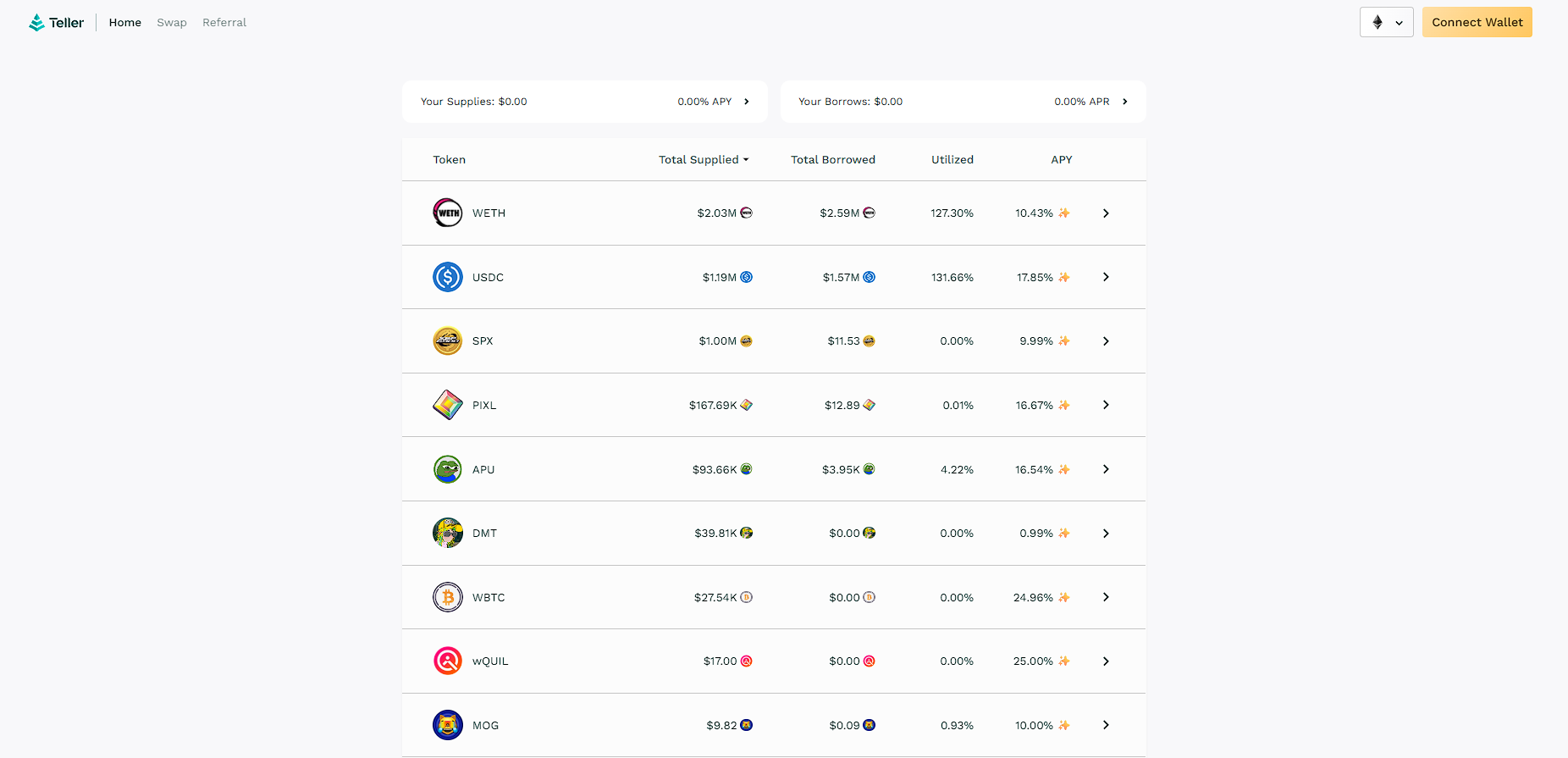
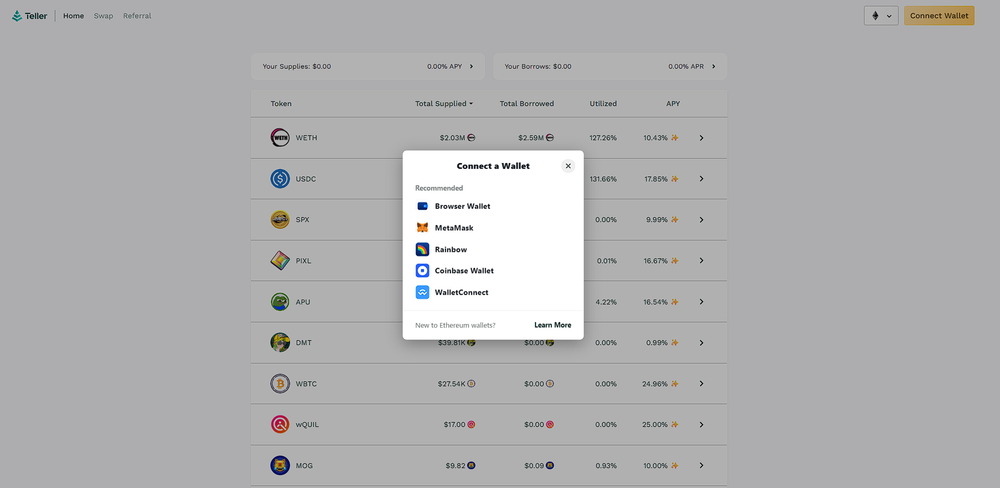
2. Connect your wallet and switch to BASE Network
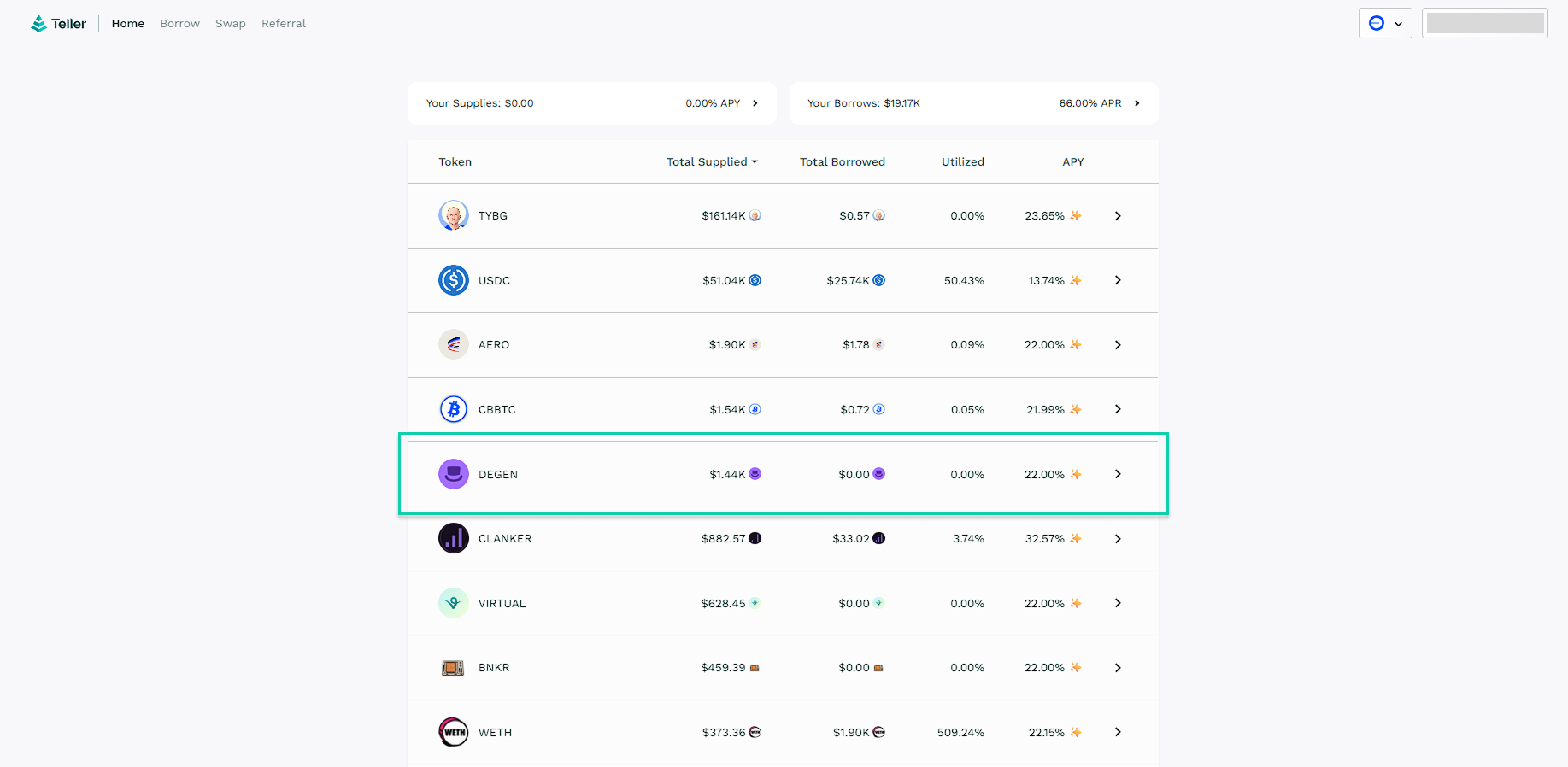
3. Select the $DEGEN lending pool
4. Deposit and start earning compounding yield